
Design Thinking & Product-Market Fit for Tech Startups
When everything seems to work on paper but the product doesn't land, the root cause is usually a gap in understanding. Design thinking closes that gap.
One of the most frustrating situations for a founder is when everything seems to be “working” on paper, yet the product still doesn’t quite land. The team is shipping, the roadmap is full, demos go reasonably well, but usage is shallow and word-of-mouth is weak. You keep hearing that people “like the idea”, but you rarely hear that they would be genuinely upset if they lost access.
When you examine situations like this, the root cause is often a gap in understanding. The team is executing hard on a solution that was never properly grounded in real user problems. It’s not that they lack discipline or talent; it’s that they started the race on the wrong track.
In Design thinking: The secret to building products that solve real problems and Design Thinking Workshops: Transforming Your Team’s Problem-Solving Skills, I argue that good discovery is not optional. Combined with How to Achieve Product-Market Fit: A Guide for Tech Startups, they form the backbone of this pillar.
**Design thinking as a discipline, not decor**
“Design thinking” has a slightly unfortunate reputation. In some organisations, it conjures images of colourful post-its and energetic workshops that ultimately change very little. That’s a shame, because at its core it’s a disciplined way of reducing waste.
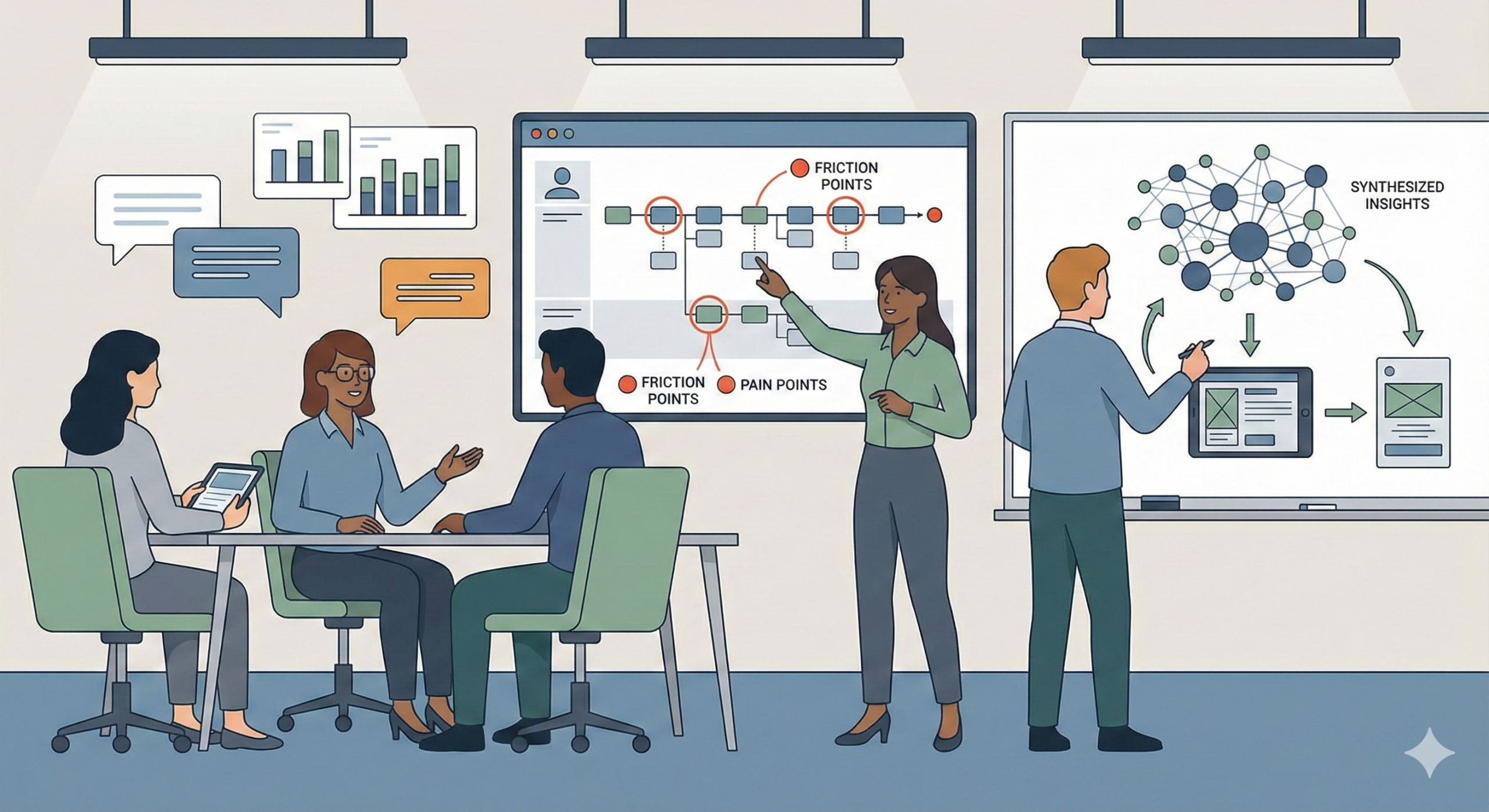
Properly applied, design thinking forces you to spend more time with the problem before you fall in love with a solution. It means talking to users, not just about their preferences, but about their constraints, workarounds and emotional responses. It means mapping journeys and identifying where friction really lies. It also means being willing to be wrong about your initial assumptions.
In Design thinking: The secret to building products that solve real problems, I walk through examples where teams discovered that the thing they thought was the problem wasn’t the problem at all. Sometimes the real issue lives upstream, in how people understand the task. Sometimes it lives downstream, in how success is measured or reported. Without a structured approach to uncovering these nuances, you risk optimising screens and features that don’t matter.
**Workshops that lead somewhere**
Many teams have tried “design thinking workshops” once or twice and come away unimpressed. The reason is often simple: there was no clear through-line from the session to what the team actually built afterwards. Ideas were generated, photos were taken, and then everyone returned to the same backlog they started with.
In Design Thinking Workshops: Transforming Your Team’s Problem-Solving Skills, I describe a format that avoids that fate. It starts with a well-framed problem statement and real user insights, not a blank canvas. It creates space for divergent thinking, but it also builds in convergence and decision-making. Most importantly, it ends with a small number of concrete experiments or design directions that directly influence the roadmap.
The value of this kind of work is cumulative. The first workshop might only change a small part of your product. Over time, though, it shifts the culture. Product discussions become more about users and evidence, less about internal opinions. Engineers and designers share a clearer picture of who they are building for. Commercial and customer-facing teams feel heard because they see patterns from the field being reflected in product choices.
**Understanding product–market fit beyond the buzzword**
Product–market fit has become one of those phrases that gets thrown around so much it loses sharpness. Founders are told to “get to PMF”, and investors ask whether they have it, as if it were a switch that flips.
In How to Achieve Product-Market Fit: A Guide for Tech Startups, I try to ground the concept again. Fit shows up in behaviour. It shows up when customers keep using the product without being chased, when they recommend it unprompted, when they are willing to put up with rough edges because the underlying value is so strong. It also shows up in numbers: retention curves that flatten, cohorts that stick around, inbound interest that isn’t purely driven by paid acquisition.
Design thinking is one of the ways you get there. By staying close to users as you iterate, you avoid building an impressive but hollow product. You learn which jobs your product is truly being hired for, and which parts of the experience are make-or-break versus incidental. You discover which segments light up when they see what you’ve built, and which segments only nod politely.
**Co-creating with early adopters**
A particularly powerful pattern is to work deliberately with a small set of early adopters. In Co-creating with early adopters to drive growth, I talk about how to choose these partners and how to structure the relationship.
The idea is to find customers who feel the problem acutely, who are motivated to see it solved, and who are willing to invest a bit of time in helping you understand their world. You then bring them into your design and discovery process. That might mean sharing early prototypes, inviting them to specific workshops, or sitting with them while they attempt to use new features in the context of their real work.
Co-creation is not about building bespoke solutions for each partner. It is about using their insight to find the common pattern underneath their needs. Done well, you end up with products and features that feel uncannily well-suited to a group of customers who share similar workflows, even if they never speak to each other.
From a growth perspective, early adopters also become references, case studies and champions. They give your sales and marketing efforts a backbone of reality. They make it easier to tell a story about outcomes rather than features.
**Bringing AI into the product development loop**
AI doesn’t sit only in your product. It can also sit in how you understand and evolve that product.
In Leveraging AI for Smarter Product Development, I describe several ways teams are already doing this. AI can help synthesise large volumes of user research, support tickets or usage data, highlighting patterns that would be hard to spot manually. It can generate alternative phrasings, flows or layouts for you to explore. It can even help you design experiments, suggesting which variations are most likely to produce meaningful differences in behaviour.
When you combine this with human-centred design thinking, you get a potent mix. The AI helps you move faster through certain steps – for example, by drafting multiple versions of onboarding copy or by summarising user interviews by theme. The human team decides which of those directions are worth testing, and how to interpret the results. The result is a product development loop that learns more with each iteration.
This ties back neatly to the AI pillar and the No-Code & Vibe coding pillar. The same tools that help you ship AI-powered features can also help you build a better understanding of what your users need from you next.
**Bringing it all together**
If there is a single message running through this pillar, it is that you cannot divorce product–market fit from how you behave as a team. You reach fit not by guessing correctly the first time, but by building a culture where you are willing to be wrong quickly, to listen carefully, and to change course when the evidence demands it.
Design thinking provides a language and a set of tools for doing that. Product–market fit gives you a way to know when it’s working. Together, they help you avoid the trap of building “busy” products that generate lots of activity but little love.
If you want to deepen your practice here, the best next reads are Design thinking: The secret to building products that solve real problems, Design Thinking Workshops: Transforming Your Team’s Problem-Solving Skills, How to Achieve Product-Market Fit and Co-creating with early adopters to drive growth. Together, they’ll give you enough structure to make your next product decisions with much more confidence.

Martin Sandhu
AI Product Consultant
I help founders and established businesses build products that work. 20+ years in product and engineering.
Connect on LinkedIn