
Escaping the Incubator Economy: Moving from Seed to Series A
Startups win demo days, join accelerators, get glowing feedback—then stall. Escaping the incubator economy requires proving demand, not collecting logos.
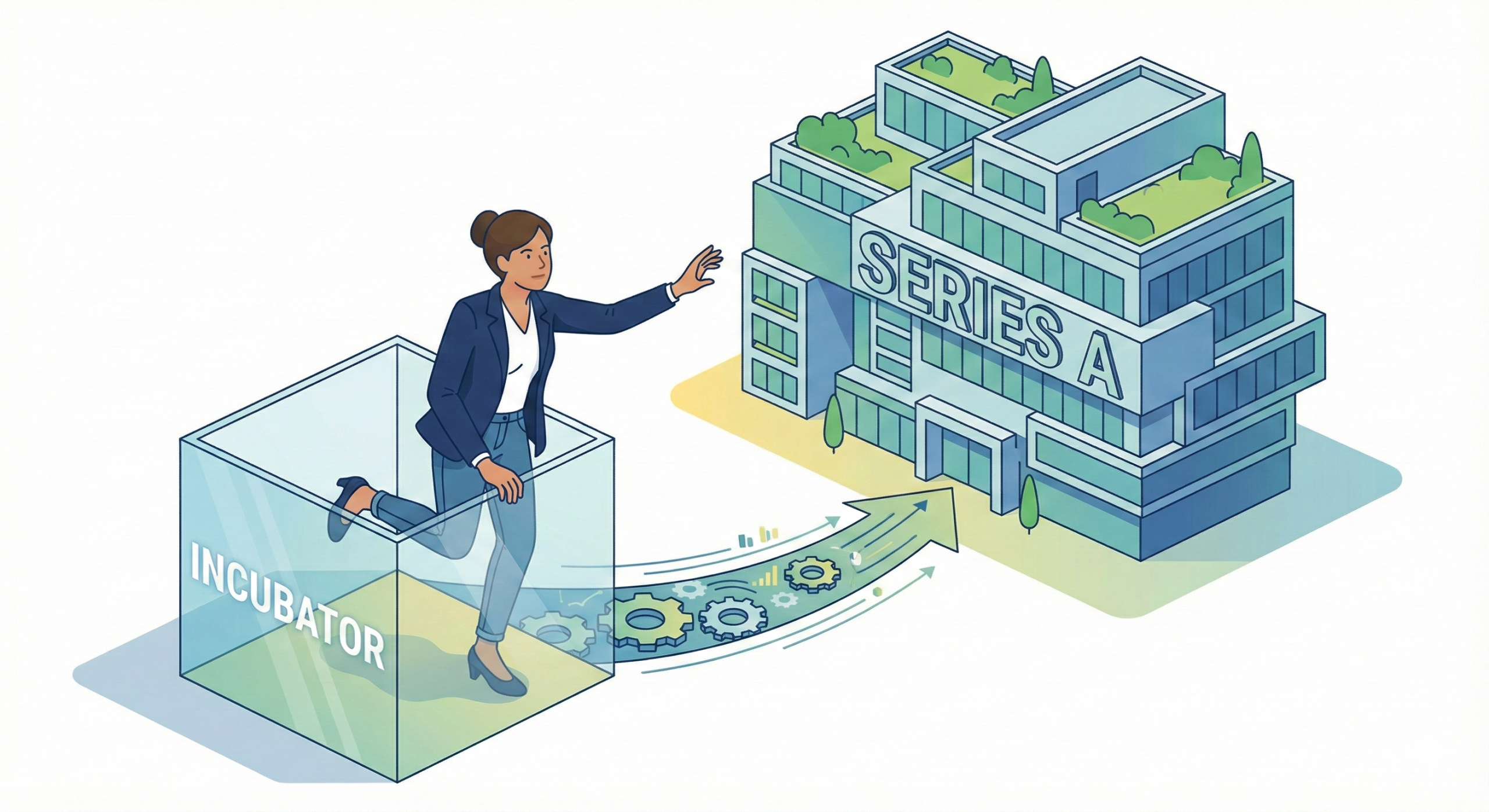
Across the UK, a strange pattern has emerged. Startups raise seed funding, run pilots, win grants, make some noise – and then stall. They don't fail dramatically. They just never quite grow up.
Sound familiar?
This is what some call the "incubator economy": a world of perpetual early-stage activity, where founders remain in a holding pattern of demos, applications and small wins, without ever building the commercial traction required for serious investment.
If you're a founder aiming for Series A, understanding this trap – and how to escape it – matters.
The shift from project to product thinking
The root cause is often a confusion between "project" and "product" thinking.
In project mode, you deliver something specific for a defined client or programme. You hit milestones, satisfy requirements, and move on. Success is measured by whether the project closes cleanly.
In product mode, you build something repeatable that solves a problem for a category of customers. Success is measured by whether people keep buying it – and whether you can scale delivery without scaling cost at the same rate.
Many seed-stage startups live in project mode. They take on pilots that are really bespoke consulting engagements. They customise heavily for each client. They say yes to everything because revenue is revenue.
That's the trade-off.
This works for survival, but it doesn't build a fundable company. Investors at Series A are looking for evidence that the startup can scale – not just that it can win one-off deals.
What Series A investors actually want
Series A investors are not looking for potential. They're looking for proof.
Specifically, they want to see:
- Proof of demand: Are customers actively seeking this solution, or do you have to push hard to create interest?
- Proof of sales: Can you close deals repeatedly, with a process that someone other than the founder can run?
- Proof of economics: Does your unit economics work? Can you acquire customers for less than they're worth over time?
If you can't demonstrate these, you're not ready for Series A – regardless of how impressive your technology or team looks on paper.
What practically can you do?
First, be honest about where you are. If most of your revenue comes from a handful of heavily customised engagements, you have consulting income, not product-market fit. That's fine as a survival strategy, but don't confuse it with progress toward Series A.
Second, define what "product" means for you. What is the repeatable thing you sell? What is standard and what is optional? Where do you say no? The discipline of defining a product forces you to make choices that consulting mode lets you avoid.
Third, prove demand before you prove technology. Investors are more impressed by a waiting list than a prototype. If you can show that customers are asking for what you're building – ideally paying deposits or signing letters of intent – that's stronger than any demo.
Fourth, build a sales motion that works without you. If only the founder can close deals, you have a job, not a company. Start documenting your sales process, training others to run it, and measuring conversion rates at each stage.
Fifth, get metrics in order. Series A investors will ask about customer acquisition cost, lifetime value, churn, and gross margin. If you don't know these numbers, you're not ready. If you do know them and they're ugly, at least you know what to fix.
The real ask
The transition from seed to Series A is not just about hitting revenue targets. It's about proving that you've built something repeatable, scalable, and economically viable.
Many good teams get stuck in the incubator economy because they never make this shift. They keep winning small grants, running pilots, and refining decks – without ever building the commercial engine that would let them grow.
Escaping that trap requires honesty, focus, and a willingness to stop doing things that feel like progress but aren't.
If you'd like help building your path from seed to Series A, get in touch.
Martin Sandhu
AI Product Consultant
I help founders and established businesses build products that work. 20+ years in product and engineering.
Connect on LinkedIn